The Early Middle Ages (476-999)
- 480 b. Benedict of Nursia, who wrote the normal Rule for Western monks to the present
- Dionysius the Pseudo-Areopagite writes
- 521 b. Columba, Irish missionary to Scotland working from the isle of Iona
- 540 b. Columban, Irish missionary to the continent when it was struggling with a resurgence of paganism
- 529 The Council of Orange approves the Augustinian doctrine of sin and grace, but without absolute predestination
- 529 Justinian publishes his legal Code
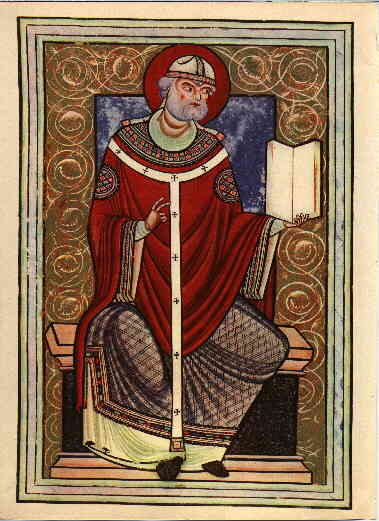
- 540 b. Gregory the Great
- 560 b. Isidore of Seville, whose Book of Sentences was the key book of theology until the twelfth century
- 575 Gregory the Great becomes a monk
- 590 Gregory the Great becomes pope. He was a very effective and popular pope during a time when the government was weak. He fed the peasants and protected farms and villages from Lombard invasion. His development of the doctrine of purgatory was instrumental in establishing the medieval Roman Catholic sacramental system
- 596 Gregory sends Augustine of Canterbury to convert the pagans in England. He imposed the Roman liturgy on the old British Christians
- 602 Through Gregory's influence and his baptism of a Lombard King's child, the Lombards begin converting from Arianism to Orthodoxy
- 622 Mohammed's flight from Mecca to Medina, the beginning of Islam
- 635 The Nestorian church did not disappear after the council of Ephesus in 431. They evangelized east. By 635 Nestorian Christianity had reached the heart of China, but it disappeared after two hundred years
- 663 Synod of Whitby reconciles the old British liturgy and the Roman liturgy
- 680 b. Boniface, who brought Anglo-Saxon Christianity to the pagans in Germany. He cut down the pagan's sacred tree and built a church out of it
- 8th Century Composition of Be Thou My Vision
- 711 Islam has spread from India to North Africa. All of North Africa is under Islamic control
- 720 Muslims take Spain
- 726-787 The iconoclastic controversy. Emperor Leo III attacked the use of images. John of Damascus defended the use of icons in worship by differentiating between veneration and worship. He also argued that the use of images is an affirmation of Christ's humanity, because a real person can be depicted. The opposition responds that images of Christ are not valid depictions because they can only represent his humanity, but not his divinity
- 731 Bede's Ecclesiastical History published
- 732 Europeans turn back the Muslims at the Battle of Tours
- 750c Donation of Constantine written about this time
- 754 Pepin III's donation helps found papal states
- 787 Council of Nicea supports the decision of John of Damascus concerning icons. This decision was not well recieved in the West because John's words for veneration and worship were difficult to translate
- 800 Pope Leo III crowns Charlemagne head of the Holy Roman Empire (a.k.a. the Nominally Christian Germanic Kingdom). His dynasty is called the Carolingian Empire. His reign is the cultural high point of the Early Middle Ages
- 843 Treaty of Verdun divides Carolingian Empire
- 861 East- West conflict over Photius begins
- 875-950 The Dark Ages. The Carolingian Empire was weakened and was assailed by new invaders. This period also marks the low point of the papacy
- 909 Monastery at Cluny founded