The High Middle Ages (1000-1299)
- 1014 Pope Benedict VIII officially added filioque to the Nicene Creed. It means that the Holy Spirit proceeds from the Father and the Son. He did this to insist on the equality of the deity. But the Eastern Church insists that the Holy Spirit came from the Father through the Son. They are offended that the West altered the Creed without an ecumenical council
- 1033 b. Anselm, father of scholasticism. He proposed the
- 1054 East west split. Pope Leo IX's delegate, Cardinal Humbert, laid a sentence of anathema on the alter of St. Sophia, the most prestigous Eastern Orthodox church. The two churches are permanently separated
- 1073 Pope Gregory VII excommunicated Emperor Henry IV.
- 1077 Emperor submits to Pope over investiture
- 1079 b. Peter Abelard, the Refiner of Scholasticism. He came to some heretical conclusions. For example, he believed that the death of Christ was just a moral example for us to follow. His autobiography is called A History of Calamities, in part because he was emasculated for having an affair with his young neice
- 1079 Under the Seljuk Turks, the Muslims are more determined than previously to keep the Christians from making pilgrimages to the Holy Land
- 1093 b. Bernard of Clairvaux, the most influential person of his day. He helped reform the monastaries. He was a great preacher, in spite of his allegorical exegesis. And he was Augustinian in his doctrines of grace, which later gave Calvin and the other reformers an anchor in the High Middle Ages
- 1093 Anselm becomes archbishop of Canterbury
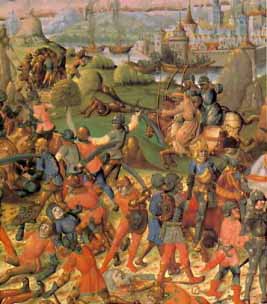
- 1096-1099 The First Crusade fought for lofty ideals. The pope wanted to save Constantinople, save the Byzantine Empire, and thus heal the breech between the Eastern and Western Church. They were able to temporarily regain the Holy Land
- 1115 Bernard founds monastery at Clairvaux
- 1122 Concordat of Worms ends investiture controversy
- 1140 b. Peter Waldo in Lyons, France. He is the founder of an old, old protestant church (300 years before Luther). The Waldensian church still exists in some parts of the world today, but in most countries it merged with the Methodists and Presbyterians. Waldensians stress the authority of scripture and lay preaching. They also come to reject salvation by sacraments
- 1147-1148 The Second Crusade. Bernard of Clairvaux was the chief motivator of this crusade, but somehow his reputation survives it. It was a disastrous failure. The failure was blamed by the Westerners on the lack of committment of the Eastern Church. The wedge is driven deeper
- 1150 Universities of Paris and Oxford founded
- 1179 Two of Waldo's followers (called Waldensians) are laughed out of the Third Lateran Council after being tricked into saying that Mary was the mother of Christ. They didn't know they were agreeing with Nestorius
- 1184 Waldensians are declared heretical
- 1187 Muslims retake Jerusalem
- 1189-1192 The Third Crusade is an ineffective attempt to recover Jerusalem
- 1200-1204 The Fourth Crusade. The Crusaders finished this crusade by looting Constantinople, the seat of the Eastern Orthodox church. So much for the lofty ideals of the First Crusade
- 1208 Francis of Assisi renounces wealth
- 1209 Innocent III proclaims a "crusade", a papal inquisition, against the Waldensians
- 1212 The Children's Crusade. The children felt they could take the Holy Land supernaturally because they were pure in heart. Most of them were drowned, murdered, or sold into slavery
- 1215 Fourth Lateran Council requires annual communion for salvation. Also condemns the Waldensians. They are persecuted for the next 600 years. They sought refuge in the Alps, and thus were not directly involved in the Reformation of Luther until later
- 1216 Papal approval for the Dominicans, the Order of Preachers. Their purpose was to oppose heresy with piety, learning and zeal
- 1219-1221 The Fifth Crusade. The crusaders temporarily held Damietta in Egypt. Francis of Assisi went with the crusaders. But where they stopped, Francis kept going. He went unarmed into the presence of the sultan and preached to him
- 1224 St. Francis's Stigmata, a mystical experience of the wounds of Christ

- 1224/25 b. Thomas Aquinus, the chief teacher of the Catholic Church. Author of Summa Contra Gentiles, an apologetic handbook for Dominican missionaries to Jews, Muslims, and heretics in Spain, and Summa Theologica, the theological textbook that supplanted Lombard's Sentences as the chief theological work of the Middle Ages
- 1225 Francis writes "The Canticle of the Sun", which we know as "All Creatures of Our God and King"
- 1229 The Sixth Crusade. Frederick II temporarily gained Jerusalem by making a treaty with the sultan
- 1232 Gregory IX appoints first "inquisitors"
- 1248 The Seventh Crusade. St. Louis IX of France is defeated in Egypt. This was the last crusade. The final result of the crusades is that the western Christians drove a wedge between the Church and the Jews, between the Church and the Muslims, and between the Western and Eastern Church.