The Imperial CHurch (305-476)
- 305 The end of the Diocletian persecution
- 310 b. Apollinaris, the heretic who said that Jesus had a human body but not a human mind; He had the divine mind. Gregory of Nazianzus' reply: "What has not been assumed cannot be restored"
- 312 Constantine defeats Maxentius at the battle of Milvian Bridge and becomes Emperor of the West. Constantine had had a vision, and used the letters chi and rho (the first two letters in "Christ") as his symbol during the battle

- 312 Caecilian elected bishop of Carthage. He was lax toward the Traditores, who had saved themselves by handing over scriptures during the Diocletian persecution. And he seemed unenthusiastic about the martyrs. A group in Carthage rejected Caecilian's election on the grounds that he was ordained by a traditore. They elected a rival bishop named Majorinus
- 313 Edict of Milan gives Christians equal rights. It is issued by Constantine in the West and Licinius in the East, but Licinius soon withdraws his committment to it
- 315 Majorinus dies, Donatus is his successor. This party becomes known as the Donatist party
- 316 The Donatists appeal to Constantine, but he rules against them. Then he outlaws them and banishes them in an effort to unite the church
- 323 Eusebius completes Ecclesiastical History
- 324 Constantine defeats Licinius and becomes Emperor of both East and West. Constantine favored Christianity, which effects the face of the church even today
- 325 Council of Nicea condemns Arianism. Arius, in Alexandria, taught that Christ was the first created being, that there was a time when He was not. The council declared that Jesus was begotten, not made, and that He is Homoousios, of the same substance as the Father
- 328 Athanasius becomes bishop of Alexandria
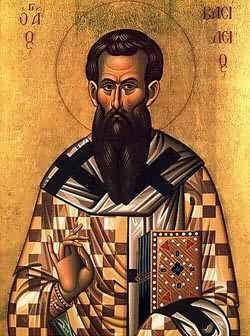
- 329 b. Basil the Great of Cappadocia, the monk who created the basic Rule for the Eastern Orthodox monks that is still in use today. Basil taught communal monasticism that serves the poor, sick, and needy. One immediate effect of the disappearance of persecution is the rise of monasticism to replace the old martyr witness
- 335 b. Martin of Tours, a great monk who is famous for his compassion for the poor
- 339 b. Ambrose the Churchman, who fought Arianism and the revival of paganism, and promoted the power of the Church.
- 341 Ulfilas converted to Arian Christianity. He takes it to the Germanic tribes, gives them an alphabet, and translates the Bible into their language. Most of the Germanic tribes became Arian Christians
- 345 b. John Chrysostom, "Golden Mouthed." He was a bold and reforming preacher, who used the Historical-grammatical method of exegesis. This was unusual, because exegetes had been looking at the allegorical interpretation ever since Clement of Alexandria and Origen

- 353 Emperor Constantius releases his pro-Arian campaign and drives Athanasius from Alexandria
- 361-363 Reign of Julian the Apostate, who converted from Christianity to paganism and restored paganism in Rome
- 361 Julian the Apostate removes the restrictions against the Donatists
- 367 A letter of Athanasius names the 66 books of the canon
- 379-395 The reign of Theodosius, who establishes Christianity as the official religion of the Roman Empire
- 381 Council of Constantinople. The Nicene position becomes dominant again, and the legal religion of the Empire. Jesus Christ is truly human, contrary to Apollinarianism, which held that Jesus had a human body but a divine mind. The Great Cappadocians are the inspiration behind the defeat of Arianism at this council. They are St. Basil the Great, St. Gregory of Nazianzus, and St. Gregory of Nyssa
- 382 A council in Rome affirms the authority of the New Testament canon. It is important to remember that the content of the canon was not a conciliar decision. The church recognized, or discovered, the canon. The church did not determine the canon
- 386 Augustine was converted in a garden in Milan after hearing a child saying "Take up and read!" He took up Romans 13: 13-14.

- 387 Augustine baptized by Ambrose
- c. 389 b. St. Patrick. He was a British Romanized Christian who established Christianity in Ireland
- 390 b. Leo the Great, an outstanding pope. He was influential in Chalcedon. He also argued for papal supremacy and showed political leadership in his negotiations with Attila the Hun
- 391 Augustine ordained a priest in Hippo, North Africa
- 393 The Council of Hippo recognizes the canon. To be recognized as canonical, a book had to be Apostolic, fit in with the other scriptures, and have been of fruitful use throughout the church up to that time
- 395 Augustine becomes bishop of Hippo
- 398 John Chrysostom becomes bishop of Constantinople
- 397-401 Augustine writes Confessions
- 411-430
Augustine's Anti-Pelagian writings. Pelagius rejected the idea
that we all fell in Adam (Federal Headship), original sin, and the
sin nature. We could earn our salvation by works, so grace is not
necessary.
Augustine insisted that we all sinned in Adam, and spiritual death, guilt, and our diseased nature is the result. God's grace is necessary not only to be able to choose to obey God's commands, but to be able to choose to turn to God initially for salvation.
- 413-426 Augustine writes The City of God. Some people blamed the fall of Rome on the Christians, saying it happened because Rome abandoned paganism. This is Augustine's responce, along with many diversions.
- 418 The Council of Carthage anathematized the teachings of Pelagius.
- 431 Council of Ephesus. Jesus Christ is one person, contrary to Nestorianism, which held that Christ was two persons, one divine and one human
- 448 Leo writes an epistle to Flavian, The Tome of Leo, to encourage him. It encapsulates the Christology of the church, drawing from Augustine and Tertullian
- 451 Council of Chalcedon. Eutychianism is condemned, Dioscorus is deposed, The Tome of Leo is confirmed. Jesus Christ is "two natures, the Divine of the same substance as the Father (against Arianism), the human of the same substance as us (against Eutychianism), which are united unconfusedly, unchangeably, indivisibly, inseparably(against Nestorianism)." The church remains divided over these issues for the next 200 years